
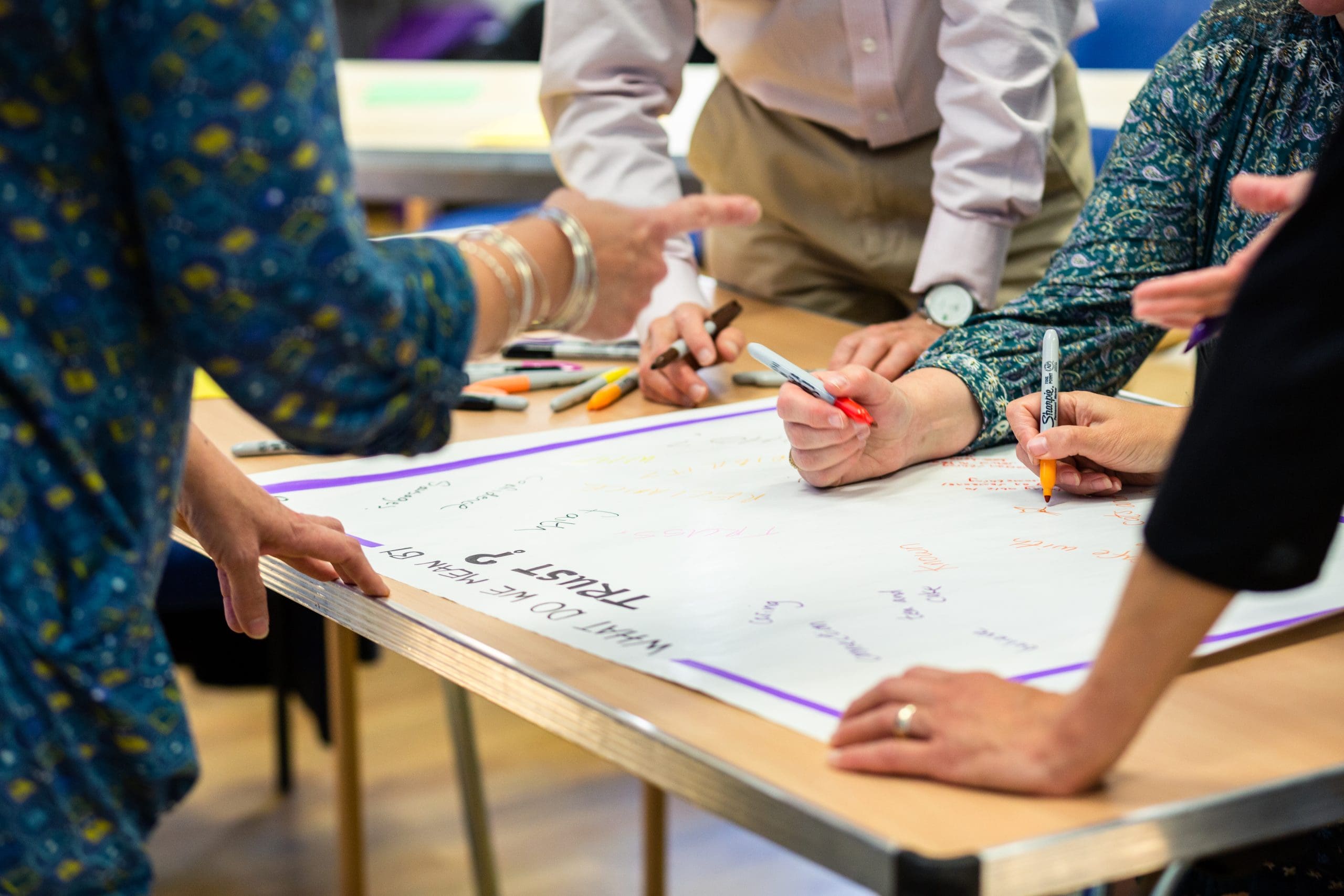
When you hear the word facilitation, you probably imagine someone – a facilitator – standing in front of a group of people. The people are busy doing some kind of work, lead by the facilitator at the front of the room.
But are they delivering training, or facilitating?
To the untrained eye, a facilitator and a trainer might look the same, but while the work they do is inextricably linked and intertwined, they are, in fact quite different. There are of course similarities and there are definitely “grey” areas in between.
But they are different.
Let’s break down the key differences between facilitation vs training:
Any good trainer will use a facilitative style – they will engage participants in conversation, prompt discussion and use a variety of tools and techniques to make sure whatever they are training you in actually sticks. And that looks just like what a facilitator will do.
But they differ in some fundamental aspects:
Purpose:
- A trainer is training you in something specific. The goal will be to increase your knowledge by imparting theirs. They will be a subject matter expert and without their knowledge on the training topic, the participants won’t get what they need from it. The conversations, shared experiences and contributions from those in the room will enhance the learning. But the primary knowledge source in the session is coming from the trainer.
- A facilitator on the other hand facilitates sessions where the group hold the knowledge, the ideas and the thinking. The focus is on enabling that group to share their experiences and their wisdom, and to expertly bring it all together. The purpose for doing this can vary enormously, it could be; sharing feedback on a piece of work, gathering ideas, making a plan, solving a problem or creating a vision for example. But the group does this with the information contained within the group rather than the expert knowledge shared by the facilitator.
Role of the facilitator or trainer:
- The facilitator is not a subject matter expert. Their expertise is in the process of getting people from one end of a set of discussions and conversations to the other, to create some outputs. A facilitator can facilitate virtually any subject.
Here at Jewell Facilitation, we have facilitated sessions from flooding to food, and from finance to forests. We are not experts in any of these things and we do not share any wisdom (or lack of!). The role as a facilitator is to enable to group to work together, to spark conversations and to lead them towards a particular outcome.
- On the other hand, a trainer is there to share their knowledge and expertise. They will quite possibly give you a certificate at the end to show you are now more knowledgeable at the end of the session than you were at the start.
Process:
The processes might look similar – a fair amount of group work and discussion and writing.
- But training usually needs to be more structured because the trainer needs to teach certain things, in a certain order, in the session. It usually has some quite specific materials – case studies, examples, checklists, worksheets. The trainer uses a process to deliver the content, but the content drives the process.
- By contrast, facilitation may be more or less structured depending on the session. It will be guided by what the participants input in the session. The facilitator’s focus is primarily on the process and the people in the room and the content will be driven by both the participants and the process created.
Dynamics:
- The trainer will be more upfront and directive as they need to make sure the content lands with the participants. It doesn’t mean they won’t ask what participants think, build on shared knowledge in the room, be flexible to participants needs. But they are largely the receivers of information.
- How facilitators facilitate will vary hugely. Some will be more directive and some less so. How the session will proceed is largely dependent on the group as they are the knowledge holders.
Outcome:
- The outcome of a training session will be that the participants are more knowledgeable in a particular subject. They will now know how to do something or approach something in a way they didn’t before. The gains from the session are individual to each person (although the new knowledge will undoubtedly benefit the organisation).
- The outcome of a facilitated session will vary, but could likely be a set of actions, some new categorised ideas, some thoughts gathered about a project undertaken or a new strategic plan. There may also be a focus on relationship building, trust building or other more experiential outcomes that are often explicit in the design of the session rather than a bonus extra. There will be a focus on collaboration and collective working, team building or having worked together to create something.
The grey areas in training vs facilitation
As with anything there are always those in-betweens.
Many people do both training and facilitation and any group training session may also contain some facilitation. Some facilitated sessions are punctuated by presentations from experts and injections from knowledge experts.
Many trainers also call themselves facilitators as they use a lot of facilitative methods.
Even thought a facilitator is not there to teach you anything new, you will quite probably learn from the others in the room. So you will quite possibly have increased your knowledge.
The facilitator will sometimes need to bring in information for the group to work on, for example results of a staff survey or vision statements from other companies to inspire ideas. While the point of doing this is not to teach participants something new, technically the facilitator is bringing in new information to the group.
Why does it matter?
Getting the right person and setting expectations for the session is important. Trainers will be able to give you advice and ideas on the topic you are working on. Facilitators won’t. Trainers will increase the competency of your team, facilitators will increase the collective capacity of the team.
Although a facilitator can never be truly neutral in any discussion, they are not there to say what they think about what participants come up with. They will not directly and deliberately influence your ideas, or tell you that what they think of your new vision.
We hope you can now see the key differences between a facilitator and a trainer. If you want to know more about facilitation itself, this is a useful read.
Here at Jewell Facilitation, we provide expert facilitation for teams and organisations. So if you are now thinking ‘yes, I need a facilitator’, get in touch!